Using a Priority Matrix: Assessing Research Risk and Problem Clarity for Your Product Design Projects
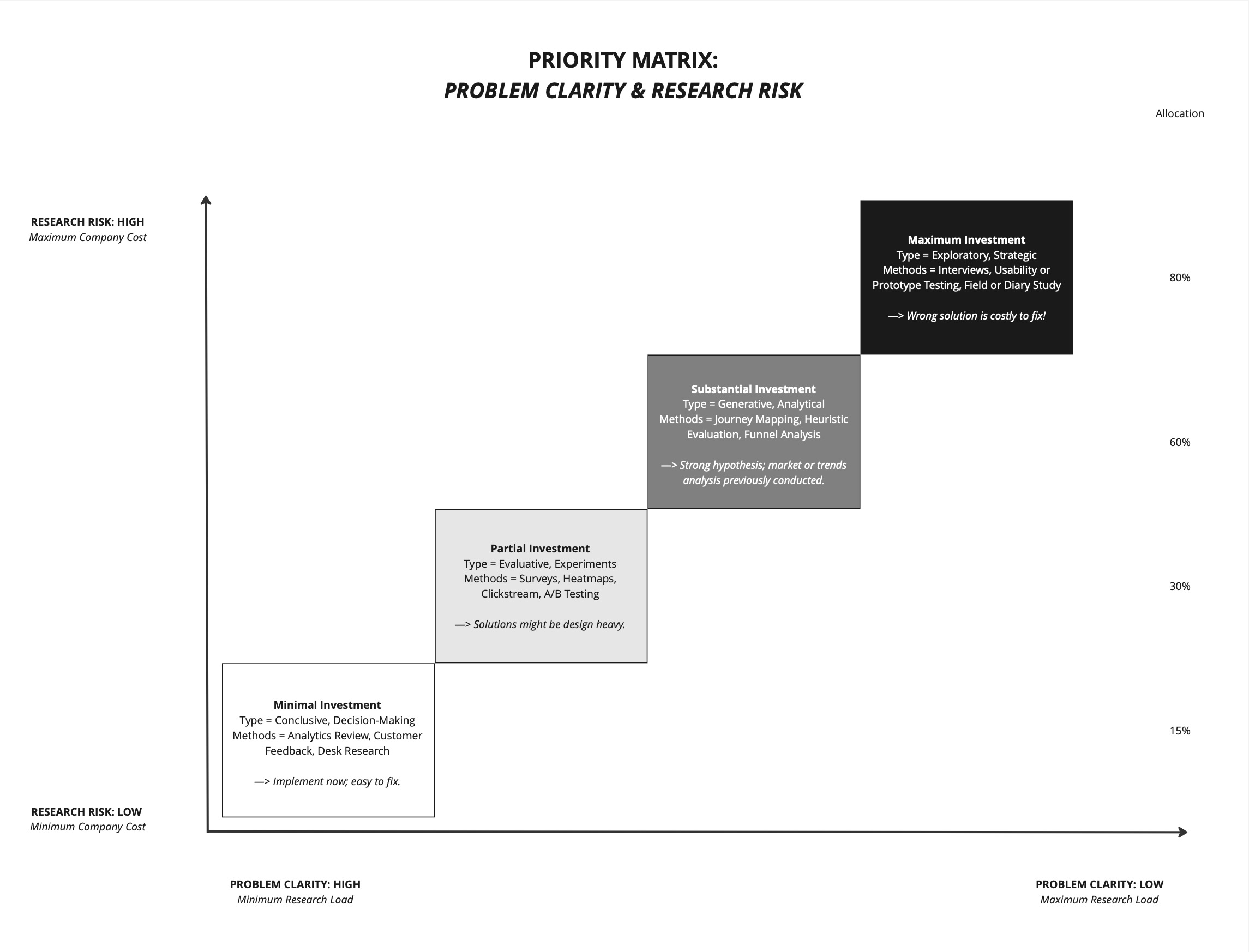
TL;DR My priority matrix helps Product & Design teams strategically allocate research resources based on problem clarity and risk, ensuring efficient use of time and budget while producing high-signal insights for maximum impact.
Your research investment should match your certainty and risk - from quick wins with clear problems to deep dives when the stakes are high and the path ahead is foggy. Product and Design research doesn’t have to be overwhelming - it’s all about matching your effort to your needs. I’ve developed a Priority Matrix that helps teams find that sweet spot between diving deep and moving fast. Think of it as your research GPS, helping you navigate between what you know and what’s at stake.
Minimal Investment: Lowest Research Risk, Highest Problem Clarity
When you’re confident about the problem and the risks are low, you can keep things light and nimble. This area focuses on getting you to a quick decision with information already available, like what geo has the highest drop-off rate at the end of the quarter. Analytics Reviews, Desk Research, and Customer Feedback come in handy. These projects are your low-hanging fruit - easy to implement and simple to adjust if needed, at just 15% of your research bandwidth.
Partial Investment: Low Research Risk, High Problem Clarity
Got a clear issue but not sure about existing data? Take an evaluative approach and conduct some experiments. You might be addressing some small bug fixes here. Use some sketches or wireframes alongside promptframes to enhance ideation and iteration. Short Surveys, Heatmaps, Clickstream and A/B Tests often do the trick, letting you validate design decisions without getting bogged down. These projects are your quick wins, typically needing about 30% of your effort.
Substantial Investment: High Research Risk, Low Problem Clarity
Things get more interesting when you know what you’re dealing with but the stakes are higher, like maybe when you’re trying to fix bigger bugs or reduce churn rates. This is the point where we’re conducting generative studies that require deep analysis. Here’s where Journey Mapping, Heuristic Evaluation, and deep Funnel Analysis shine, helping you build on existing insights and market knowledge. These projects deserve about 60% of your attention - they’re substantial but focused.
Maximum Investment: Highest Research Risk, Lowest Problem Clarity
And then there are those big, complex challenges - when you’re not quite sure what you’re solving and getting it wrong would cost time and money across teams and departments. Think new feature development. Exploratory and strategic investigations are your best friends here. These are your deep-dive moments, calling for in-depth Interviews, Field and Diary Studies, and thorough Usability Testing. At around 80% of your research investment, these projects deserve this investment because the wrong solution here is costly to fix - but get it right, and you’ve unlocked transformative insights.
This matrix isn’t just about organizing research - it’s about giving teams the confidence to know when to sprint and when to explore. It helps you speak at the language of careful investigation and efficient delivery, making sure every research dollar works as hard as possible.